
The person responsible for processes and organisation has three projects on her list, all of which are marked as 'strategically important', and she knows she cannot tackle them all at once. The head of customer service has forty manual processes and four fewer full-time equivalents than she did two years ago. She knows that automation is needed here, and she knows she cannot implement everything all at once. The sales manager is working on a campaign for heat pumps. Enquiries are coming in, quotations are taking too long to prepare, and margins are falling. He knows that the processes here aren’t keeping up. The IT manager has all the lists on his desk, each marked ‘very urgent’. He simply doesn’t have the resources to tackle all the projects at once. He starts with the task that’s being shouted about the loudest.
All four assess the importance according to their own criteria. All four are right from their own perspective. Together, this results in four conflicting pictures. And none of them shows where the company as a whole should start. The management observes the discussion and delegates the task of resolving it.
If the budget is large enough, an external consultancy is brought in; they charge five hundred thousand euros, deliver a hundred slides and leave. The four operational managers are left with the very question they started with.
Welcome to the prioritisation conundrum.
What established methods can achieve
Once a process has been selected, tried-and-tested methods come into play:
- Lean Management provides principles for reducing waste, with the seven Muda categories, the pull principle and the concept of flow.
- Kaizen drives continuous improvement through small steps, led by the employees themselves.
- 5S organises and standardises the workplace.
- Value stream mapping visualises material and information flows and highlights waste.
- PDCA organises the improvement cycle.
These methods have proven their worth in thousands of projects. The point is: they assume that you have already made the selection beforehand.
Where the methods remain silent
A real-world example. A value stream analysis typically begins with a sentence like this: ‘First, determine which products or sub-processes are to be examined.’ ‘Determine’ is not a method; it is an instruction. How does one determine?
In a Kaizen context, the answer is usually: start where waste is obvious, or where staff suggest improvements. Both are valuable indicators. However, they only capture what is visible. With hundreds of processes, the majority remain hidden. Waste that nobody reports because it has become the norm. Workflows that nobody questions because they have always been done that way. Without a structured review, they remain undetected.
The question of which process a company should tackle systematically first depends on factors that established methods do not take into account. How repeatable are its steps? How good is the data available? How many decisions do employees have to make during the process? And, once AI comes into play: is the process even suitable for AI-supported automation?
Why the question of prioritisation is difficult
Firstly, the lack of a common language. Customer service measures in terms of cases resolved per day, sales in terms of margins and new contracts, and IT in terms of system dependencies. Each language is accurate within its own area. Across departments, however, it is almost impossible to compare these metrics.
Secondly, the lack of visibility. A broken process is usually only visible within the department experiencing it. Customer service has noticed for months that a bill run is causing problems. They report it internally, work around it and find ways to get by. Sales knows nothing about it. Senior management knows nothing about it either. Only when the process is so broken that a customer is lost, the regulating authority gets involved or the operating profit suffers does it become an issue for the other departments. Until then, it remains in a silo.
Thirdly, the lack of authority. The division head makes decisions for their own division. Cross-divisional decisions fall to senior management, who have little time for them. In practice, therefore, they are rarely actively taken. The loudest voice prevails.
As a result, process optimisation remains a divisional issue. Everyone optimises their own silo; nobody looks at the bigger picture.
How AI is changing this
With the emergence of AI tools, the question of prioritisation has become more difficult. The reason: AI decisions arise from a sense of necessity: 'We have to do something with AI.' Every post on LinkedIn talks about successful AI deployments, and people rave about it at conferences. You hardly ever read reports about pilot projects that have been scrapped. A supplier comes in and puts a template on the table in which every other process is marked as ‘AI-compatible’.
Driven by this motivation, a process is selected and automated. Sometimes it works. Often it doesn’t: the data set is too thin, the process requires explainability, or a traditional approach would have been more cost-effective and robust. The result is typically a bot that helps no one.
Lean, Kaizen and 5S do not perform this suitability assessment. They date from a time before AI. Today, prioritisation requires an additional level for which the familiar methods are not designed.
A compass for prioritisation
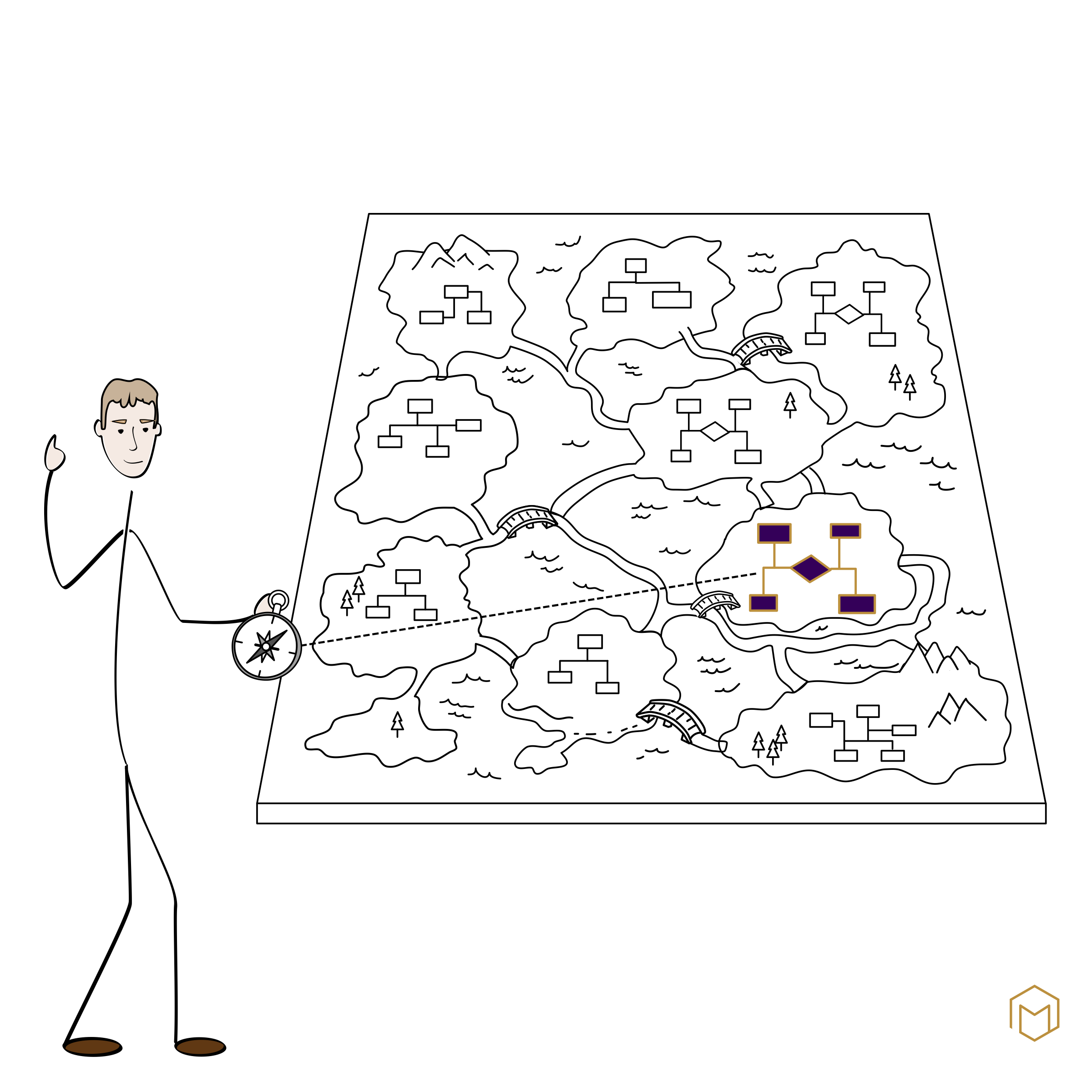
It is precisely to fill these gaps that I developed HOIKEI. The name comes from Japanese and means ‘compass’, literally ‘direction-finding device’. A compass points north. You choose the path yourself.
HOIKEI answers the question that precedes optimisation: which processes deserve attention first? Twenty questions yield an assessment along two axes – optimisability and expected benefit – and map out all processes on a single map. Anyone with forty candidates can see them side by side and base their decision on this. This also provides IT with a well-founded order of priority, rather than having to react to the loudest demands.
HOIKEI also addresses the AI question. The twenty answers result in an automatic designation as an AI candidate. Anyone wishing to examine this in greater depth can use a supplementary stage comprising seven questions on necessity, prerequisites and risks. The result is one of three assessments: suitable for AI, possible with reservations, or not recommended. Vendor claims regarding AI suitability can thus be assessed in a structured and independent manner.
And HOIKEI completes the cycle. Following implementation, the process is reassessed using the same questions. A comparison with the baseline shows whether the optimisation has been effective and where the next point of action lies. This transforms a one-off measure into a continuous improvement process.
HOIKEI works in conjunction with Lean, Kaizen and 5S. It is integrated ahead of these methodologies, supplements them with the AI aspect and, ultimately, measures whether the optimisation has been effective.
 The question of prioritisation is difficult, but solvable. It requires a compass to show the way.
If you’d like to see HOIKEI in action, book a demo. In thirty minutes, I’ll show you how the assessment works using one of your processes as an example.