
Which process will you optimise first?
Standardised assessment tool for process-driven organisations. 20 questions, two scores, ROI with the click of a button. With built-in AI suitability assessment.
What does the tool offer you?
Four roles, four perspectives. Each offering a distinct outlook on the same process.
Every department assesses by its own criteria, a common language is missing.
Standardised methodology for business, IT and management.
Today vs. with HOIKEI → Customer Service ManagementManual tasks tie up staff, budget for optimisation has to be fought for.
The actual process costs and ROI numbers are good arguments for the next budget meeting.
Phase 3: Calculate → IT ManagementRequests coming in from all directions, a tight budget for implementation, and a shortage of staff.
An objective basis for prioritisation makes it easier for you to decide what comes first.
Phase 2: Compare → Executive Management & SalesMultiple optimization projects and analytical initiatives are running in parallel, yet there is no clear picture of their impact or their suitability for AI.
Investment decisions based on ROI, impact measurement and AI suitability assessments.
Phase 5: Re-assess →Why is process optimisation so difficult?
Growing process complexity.
Regulatory requirements keep increasing while teams remain the same size.
Experienced staff are leaving.
Process knowledge is lost with retirement, onboarding takes months.
Budgets are limited.
Optimisation projects are competing for the same budget.
Many manual processes remain.
Despite automation efforts, significant manual work persists.
AI promises much, the foundation is missing.
Without mature processes and clean data, AI remains an expensive experiment.
Competitive and price pressure.
Comparison portals and switching willingness are rising, margins are shrinking, customer retention is becoming more expensive.
Today vs. with HOIKEI
Five typical obstacles to optimisation, and how the methodology addresses them.
Subjective prioritisation
Which process gets optimised depends on who makes the strongest case.
Standardised questionnaire
20 weighted criteria, the same benchmark for every process.
No comparability
Every department assesses by its own criteria.
Unified methodology
Results are comparable across departments, regardless of who conducts the assessment.
Effort without a business case
Optimisation effort and benefit are rarely systematically compared.
ROI for every option
Effort, savings, additional benefit, payback period, all calculated automatically.
No impact measurement
After the optimisation, there is no measurement of whether the effort was worthwhile.
Before/after comparison
Follow-up assessments show whether the investment has been effective.
AI hype without groundwork
AI projects are launched without checking whether the prerequisites are in place.
Structured AI suitability assessment
Automatic identification of AI candidates and seven suitability questions before the investment decision.
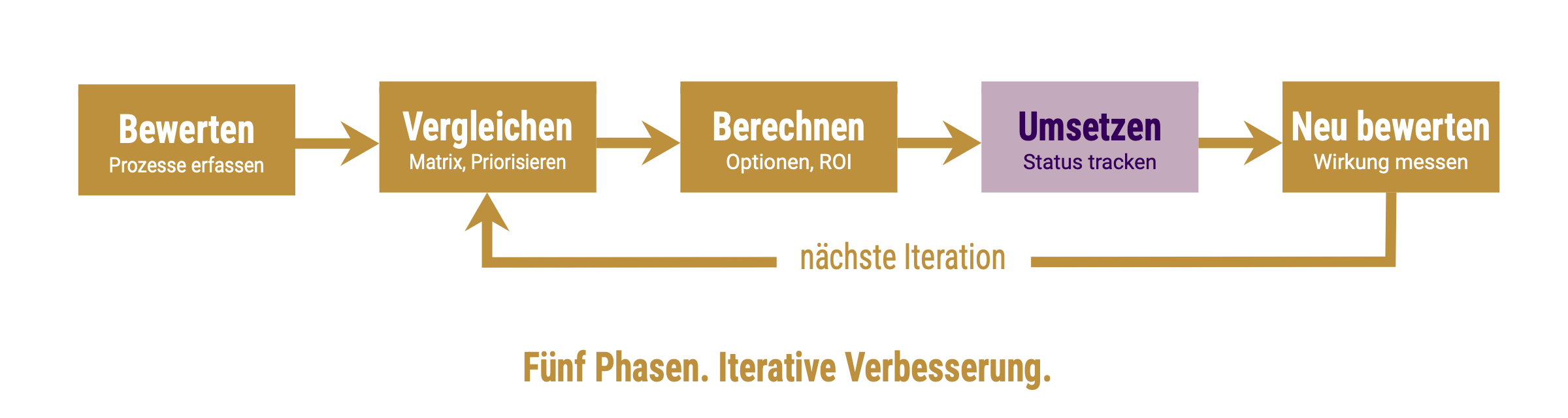
Five phases, continuous improvement
The tool carries out four phases. The optimisation itself remains your responsibility. Once the new assessment is complete, the next iteration begins: at a higher level.
 Assess
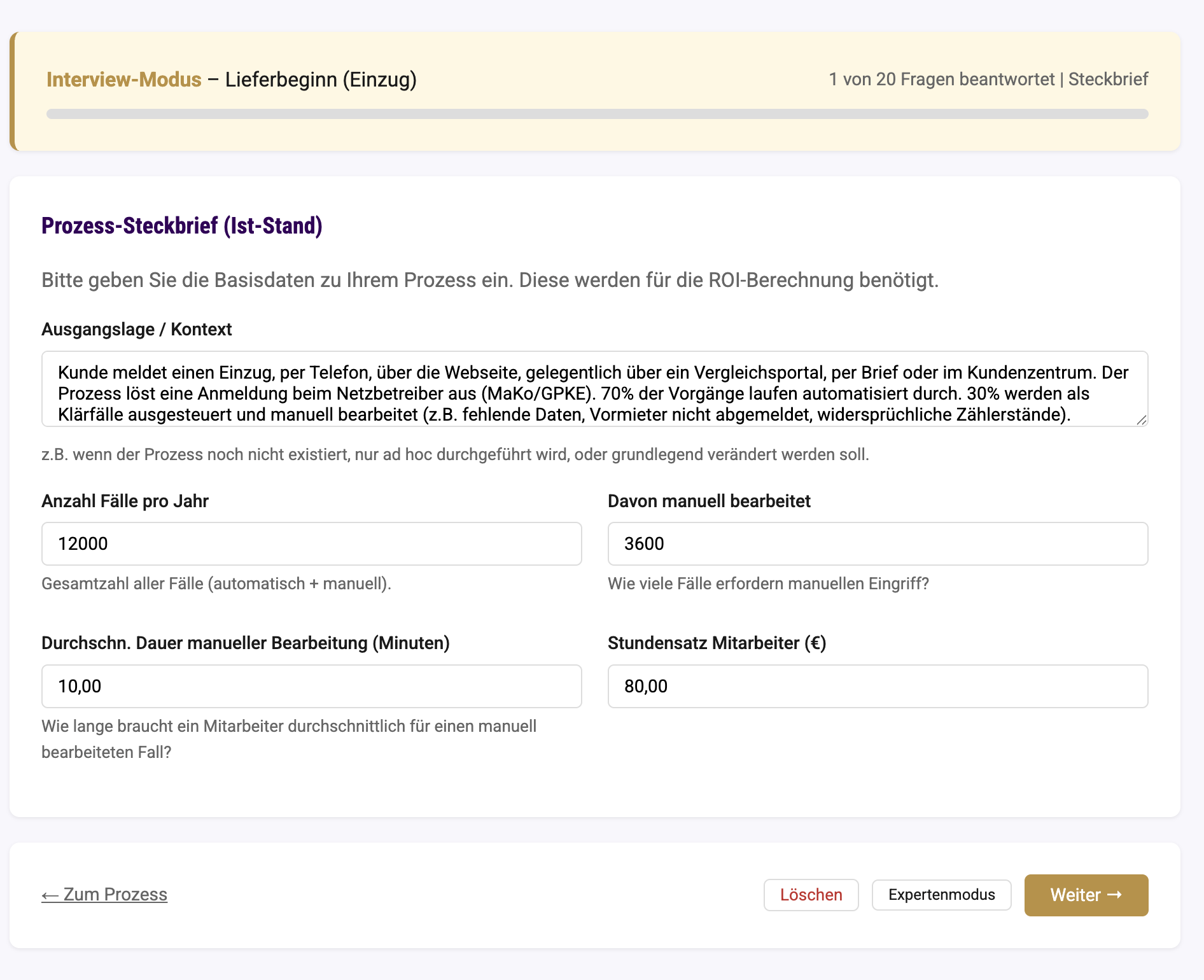
Identify multiple processes that are candidates for optimisation. For each process: a profile with case volumes, processing time and hourly rate. Answer 20 questions in the guided interview or in expert mode.
The result is a score for each process on two dimensions: How well can it be optimised? How high is the expected benefit?
Additionally, the tool automatically identifies whether a process is a potential candidate for AI. To do this, it evaluates selected questions from the existing questionnaire. You do not need to take any additional action.
AI Suitability Assessment
After completing an assessment, you can run an AI suitability assessment for any process. Regardless of whether the process was identified as an AI candidate, and regardless of which optimisation method you are planning.
Seven questions
Necessity, prerequisites and risks. Is AI the right approach, or would a simpler solution suffice?
Clear recommendation
Suitable, possible with caveats, or not recommended. With specific guidance on where preparatory work is needed.
Iterative
After an optimisation, the prerequisites may change. With each new assessment, AI suitability can be re-evaluated.
 Compare
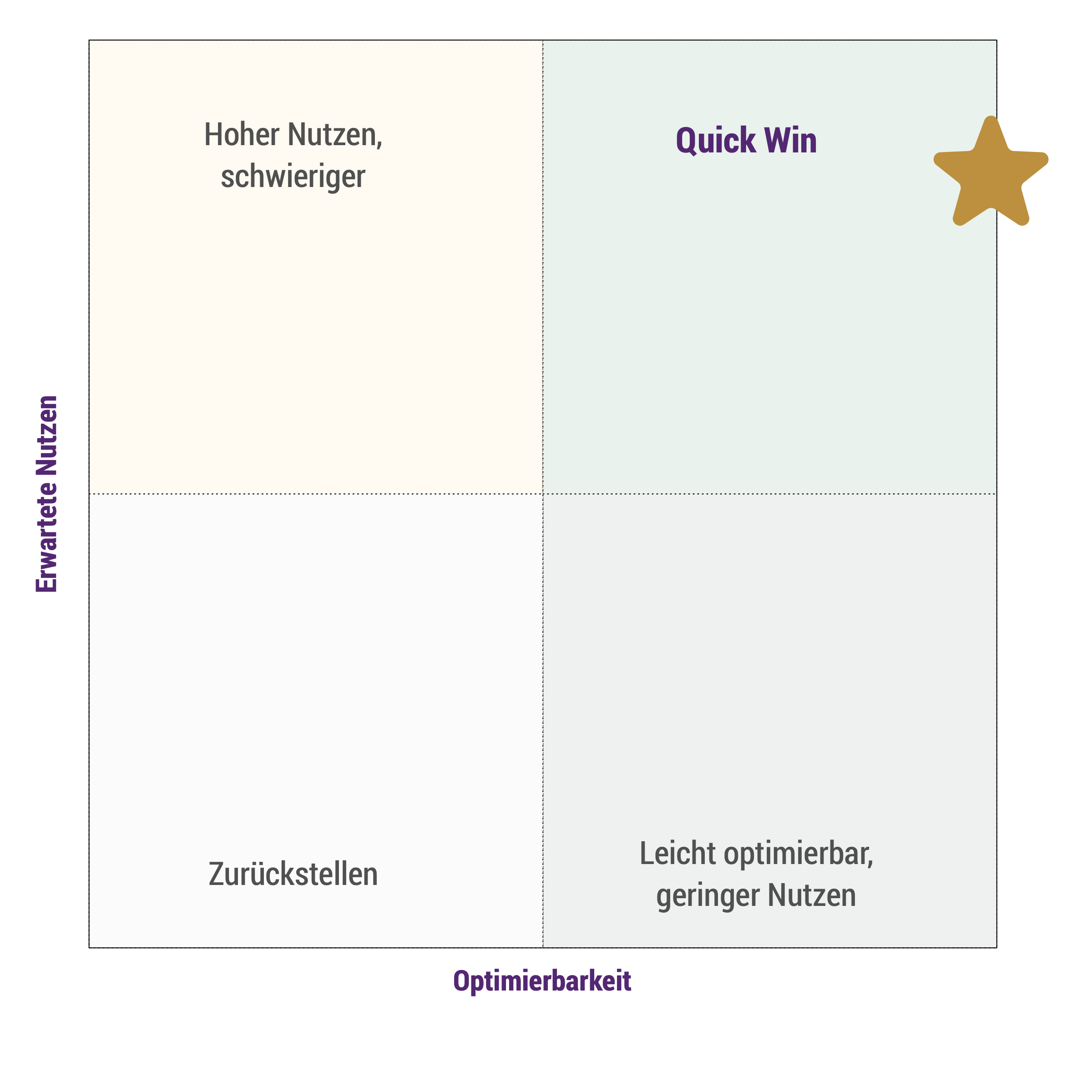
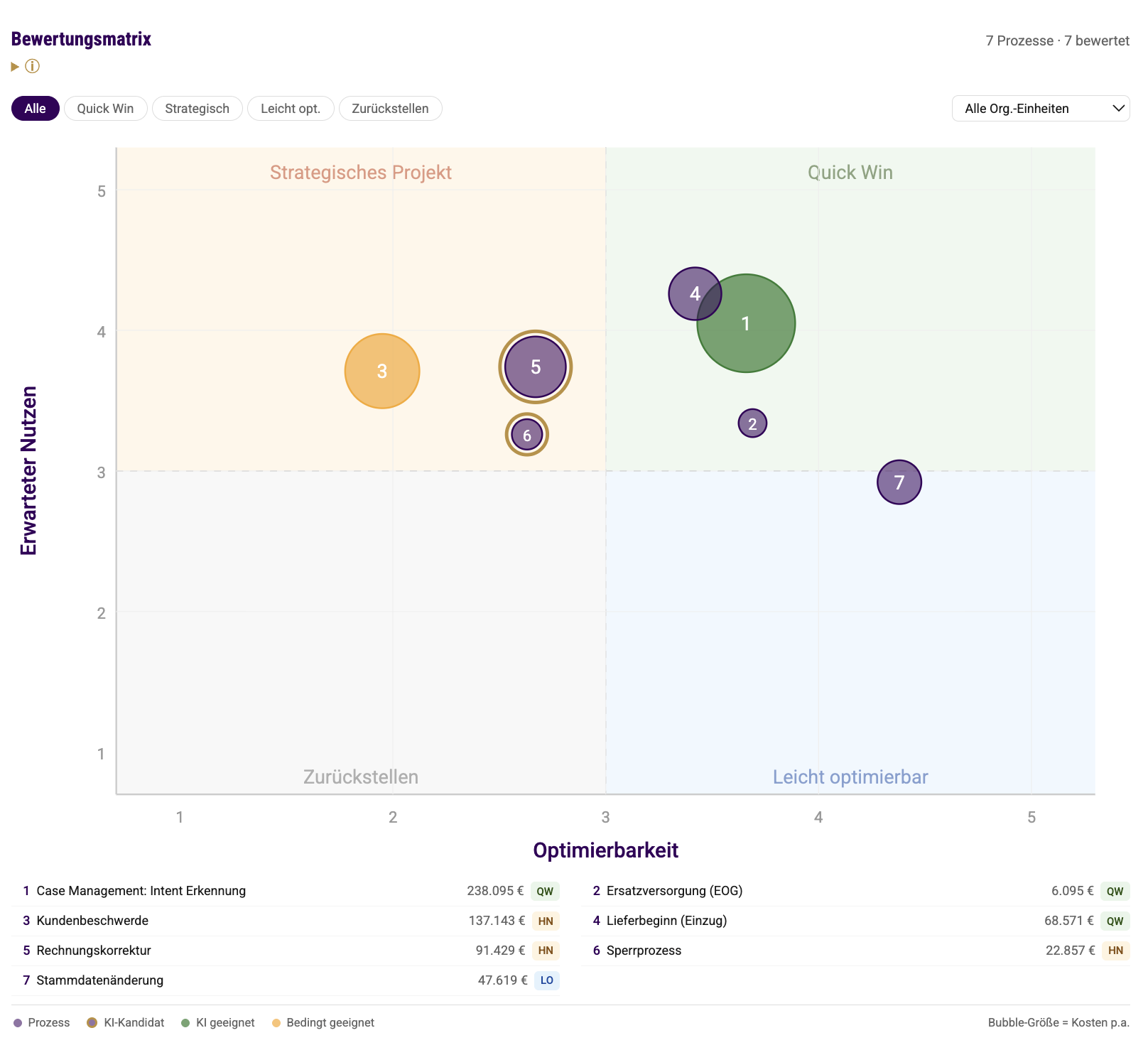
All assessed processes in one matrix: feasibility against expected value. Quick wins in the top right.
You can see at a glance which processes should be prioritised and which can be deferred. AI candidates are visually highlighted in the matrix, so you can immediately see where an AI solution might be worth considering.
The matrix updates automatically after each new assessment and always shows the current state of all processes. It becomes a steering instrument, not a one-off output.

The scores are a compass, not a GPS.
They show the direction. The decision is yours.
 Calculate
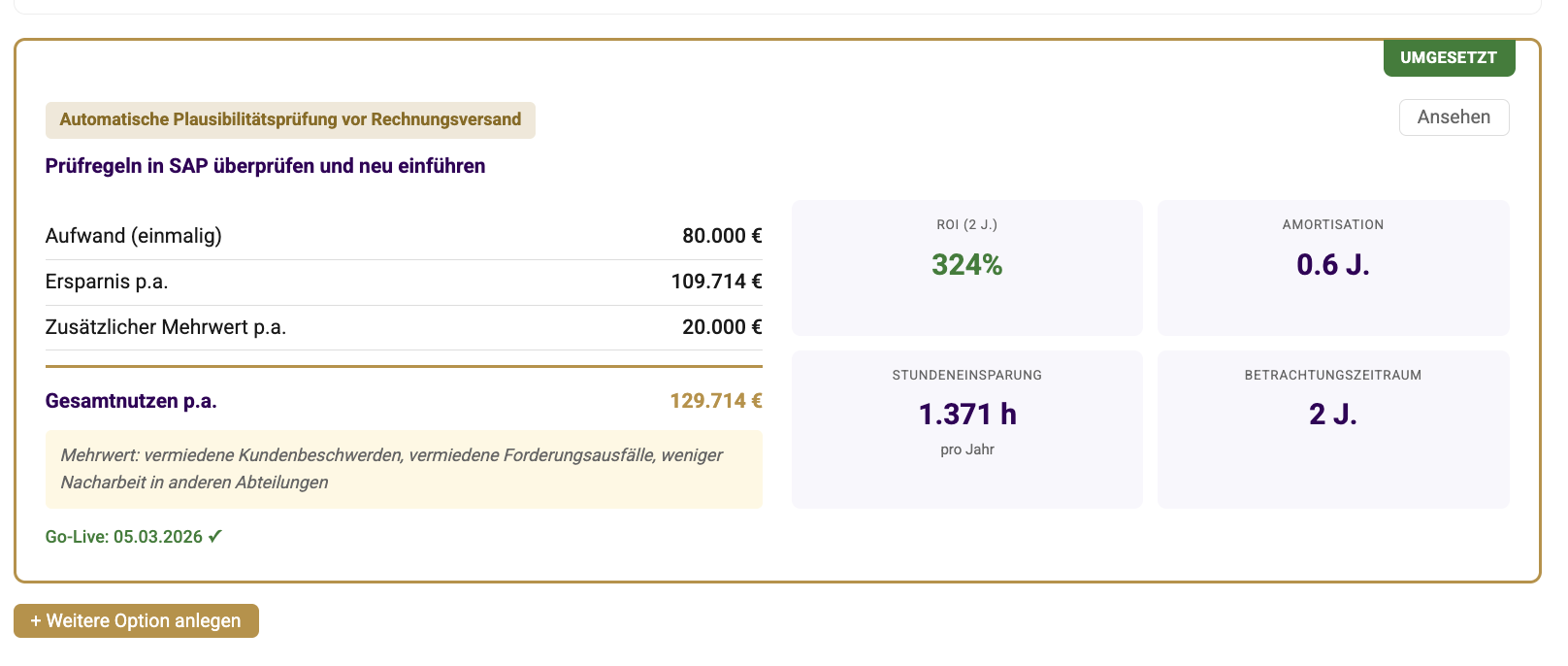
For the selected process, you create one or more implementation options. For each option: estimated effort, time savings, additional benefit. The tool automatically calculates ROI, payback period and total benefit.
You choose the option that fits your budget and IT roadmap, and mark it as your implementation decision.
What counts as benefit?
Not just time savings. Two levers feed into the assessment, and the difference is significant.
Direct savings
Reduce manual processing time, free up resources.
Quantifiable in eurosIndirect added value
Avoided rework, reduced bad debt, avoided churn.
Quantifiable, captured separatelyOptimise
Implementation takes place within your systems, with your teams. The tool takes a back seat except of status tracking right up to go-live, after which it takes a back seat. On request, we can support you through this phase as part of our regular consultancy services.
After go-live, you observe the process for two to three months before re-assessing it.
 Re-assess
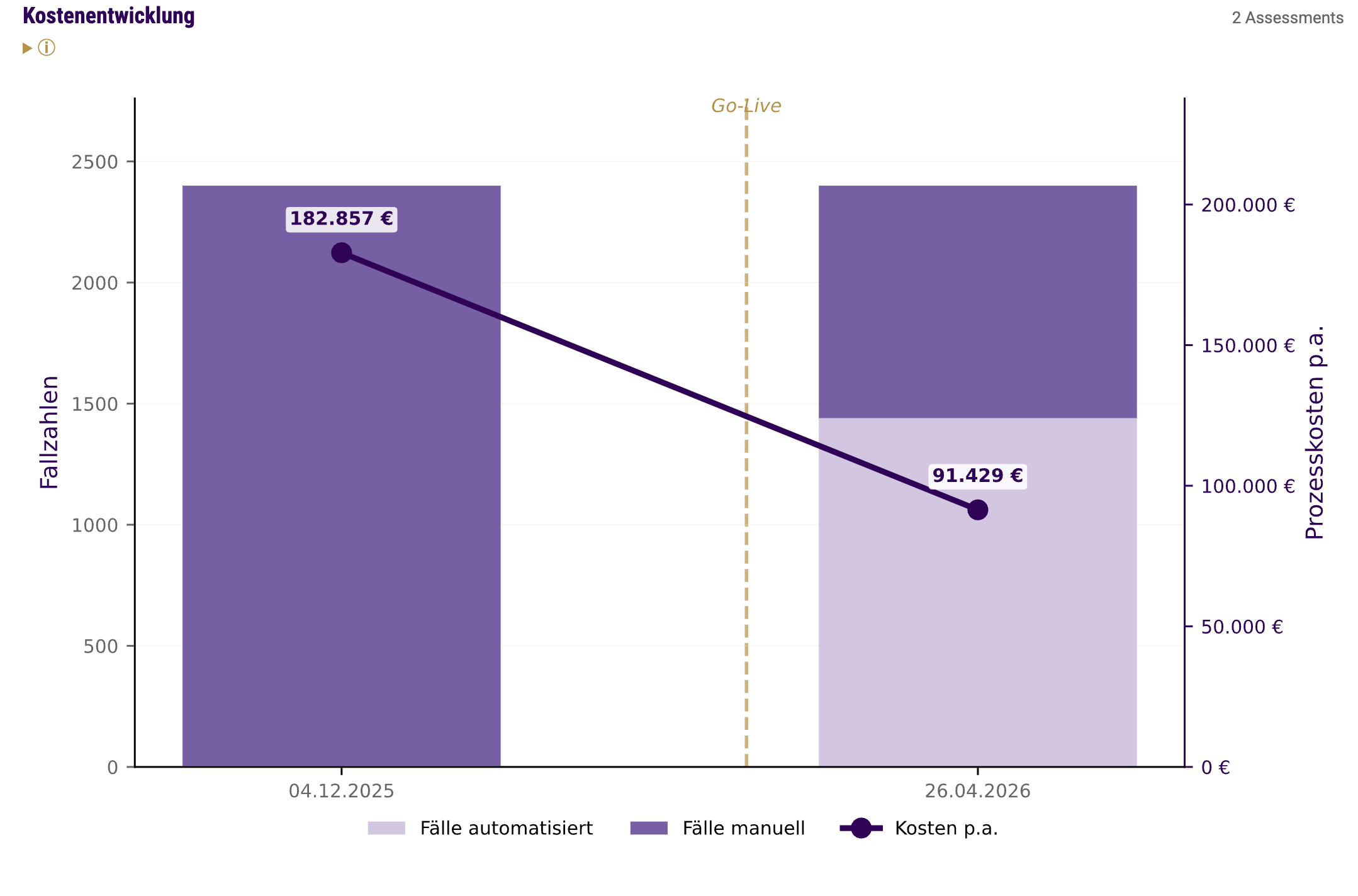
You assess the same process again. Same procedure, same questions. The tool compares automatically: Were optimisation potentials fully realised? Have process costs decreased? How has the degree of automation changed?
The assessment matrix updates automatically and shows the new state. A process that was a quick win may now sit in the "defer" area. Others move up. You reprioritise, select the next process, and the next iteration begins.
AI suitability is also re-evaluated. Has the data foundation improved through a reporting project? Have systems been connected via APIs? The suitability assessment shows whether AI has now become a realistic option.
Because improvement is an ongoing process, we work with annual licences. You invest in repeatability, not a one-off assessment.
Start flexibly, scale any time
Focus
Portfolio
Enterprise
All licences: hosted in Germany, tenant separation, GDPR-compliant.
Achieve results faster with expert support
You can use the tool on your own. If you wish, we can assist you through the assessment process.
Introduction Workshop
Half day online: prepare the process profile, walk through the first assessment together, interpret the results.
One-off
Quarterly Support
8 hours per quarter: reflection on ongoing optimisations, preparation for the next assessment, methodological advice.
Recurring
Ad-hoc Sessions
Targeted support for specific questions: interview moderation, assessment clarification, decision preparation.
On request
Support services are standard consultancy provided by OM Consulting. Get in touch for a tailored proposal.
Your data is kept in Germany
German servers (Hetzner)
TLS for all connections
DPA, TOMs, privacy policy
No external services, no analytics
Ready for data-driven process decisions?
Schedule a personal demo. I will show you HOIKEI in 30 minutes.
Frequently Asked Questions
What is HOIKEI?
HOIKEI is a process assessment methodology for utilities and energy companies. It evaluates processes against 20 standardised criteria on two dimensions: optimisation feasibility and expected benefit. Including AI suitability assessment and automatic ROI calculation.
How long does a process assessment take?
Assessing a single process takes 30 to 45 minutes in guided interview mode. Preparation of the process profile (case volumes, processing times, hourly rates) should be done in advance.
Can HOIKEI assess AI suitability?
Yes. HOIKEI automatically identifies AI candidates based on the assessment responses. Additionally, you can run a separate AI suitability assessment with seven questions for any process, which provides a clear recommendation.
How do I get started with HOIKEI?
Schedule a personal demo. In 30 minutes, I will show you the methodology using a concrete example. After that, you can start optimising your processes.