
A municipal utility company I advised wanted to automatically categorise incoming customer emails. Complaints, meter readings, contract enquiries, cancellations. The aim was clear: thousands of emails a week, a lot of manual work, and long response times. So an AI system was purchased.
The result was disheartening. Not because the AI was flawed, but because it had no access to the CRM or the billing system. Without knowing whether the sender was a private or business customer, whether an invoice was outstanding, or whether a meter replacement was due, the AI lacked context. It could read words, but couldn’t make sense of the context. The results were modest, and the amount of manual work hardly decreased.
I see this pattern time and time again: AI is brought in as a solution before the groundwork has been laid. The technology works, but there is no integration with existing systems. This isn’t a technical problem. It’s a process problem.
What is AI, and what isn’t it?
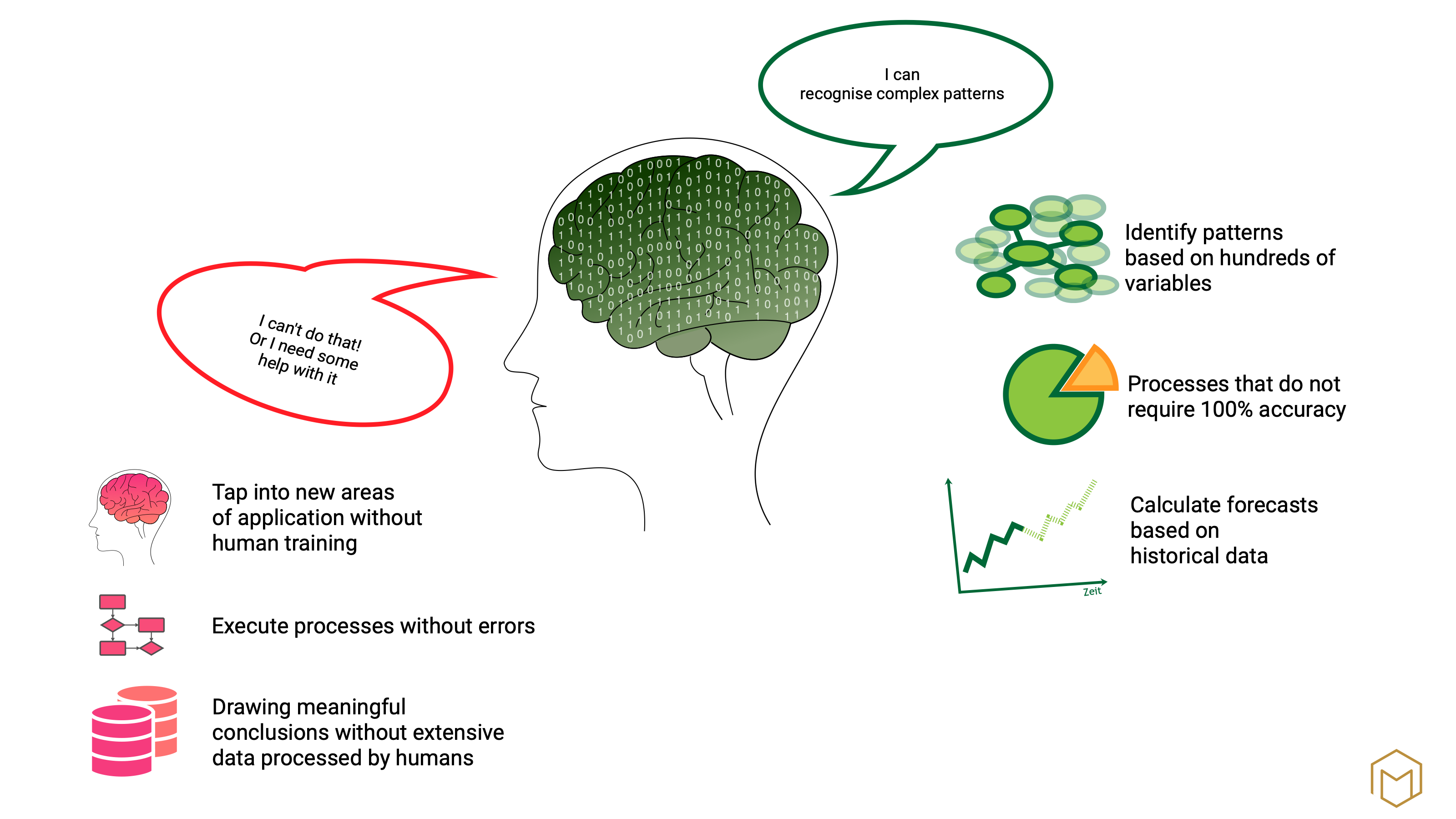
When we talk about AI today, we think of ChatGPT, Copilot or Gemini: systems that write text, answer questions and summarise documents. This is generative AI, and it is impressive. But it is only one part of what AI can achieve in the energy sector.
Then there is analytical AI: systems that identify patterns in data and make predictions. Which customers are likely to cancel? How is consumption trending? Where do faults tend to occur? These are not language models, but statistical models. Less spectacular, but often more effective in practice.
Both types have one thing in common: they are tools, not thinking machines. They are not systems designed to replace staff. They can handle certain tasks with ease, provided the conditions are right. How AI actually learns and where its limitations lie is explained in the article How Does AI Learn? Explained for Decision-Makers.
One aspect deserves attention, particularly because generative AI communicates so convincingly: we tend to attribute human characteristics to these systems. The AI ‘understands’, ‘thinks’ and ‘decides’. In reality, it does none of these things. This ELIZA effect leads to false expectations. And false expectations lead to poor investment decisions. More on this in the article The ELIZA effect and why we anthropomorphise AI.
Where AI is already being used in municipal utilities
The good news is that there are areas where AI is delivering tangible results in municipal utilities. Not just as a vision, but in practice.
Churn prevention is one of the most compelling examples. In one project, we used predictive analytics to discover that even small repayments prompt customers to cancel their contracts. The system identified customers who were highly likely to cancel. 80% of customers classified by the model as ‘likely to cancel’ had in fact left after four months. Armed with this information, the municipal utility was able to take targeted action before the cancellation notice was even on the table.
Forecasting is another area where AI really comes into its own. Load forecasts, consumption forecasts, generation forecasts for renewable energy. Here, AI works with large volumes of data and recurring patterns. That is its natural strength. But the same applies here: a forecast is an estimate, not a guarantee. Why this isn’t a disadvantage and how to interpret forecast results correctly is explained in Why AI forecasts are uncertain and that’s okay.
For a broader overview of the current situation, see AI in municipal utilities: what works today and what doesn’t.
Where can generative AI be of use in municipal utilities?
For municipal utilities, generative AI is particularly effective in internal processes: creating minutes, drafting tender documents, preparing technical documentation, and relieving staff of the burden of research. Wherever people currently spend time on routine tasks, generative AI can reduce the workload.
What it cannot do: make business decisions. A rejection letter that is linguistically flawless is worthless if the underlying assessment is incorrect. Generative AI produces plausible texts. Whether the content is correct must still be judged by a human. In the energy sector, with its regulatory requirements, this is no small matter.
Two questions can help you assess the situation: Would it be harmful if the AI made a mistake here? And: Do we have someone who can check the result? Where the answer to both questions is ‘yes’, generative AI is a useful tool. Where the answer to the first question is ‘yes’ and to the second ‘no’, you should exercise caution.
Why so many AI projects fail
These failures are rarely due to technical issues. They are caused by a lack of the necessary conditions.
Lack of system integration. The email example from the beginning illustrates this clearly: if the AI does not have access to the relevant data, it lacks context. Even the best model is useless if it operates in isolation. Integration with CRM, billing systems or customer databases is not a minor matter. It is a prerequisite.
Immature processes. If the underlying process itself is not clearly defined, AI cannot improve it. We are then simply automating chaos. Before embarking on an AI project, we must ask: Is the process actually as it should be?
False expectations. Chatbots are an example familiar to many municipal utilities. When vendors demonstrate a chatbot, everyone is impressed. Customer acceptance, however, is often virtually non-existent. Customers want to be understood and have their issues resolved; they do not want to communicate with a system that does not recognise their contract number. In most cases, no one even checks whether customers actually want this kind of technology in the first place.
No turning back. Many AI projects are launched without clear criteria for success. There is no defined point at which a decision is made: is this working, or should we call it off? Without measurement, there is no evaluation. Without evaluation, there is no learning curve.
How do you get started without getting carried away?
The most realistic way to get started is to keep it small and specific. Not a grand AI strategy, but a single use case with a clear outcome.
The question is not “Where can we use AI?”, but “What problem do we want to solve, and is AI the right way to go about it?” Sometimes the answer is yes. Often the answer is: a simpler solution will do.
A tried-and-tested starting point:
Choose a process that involves a significant amount of manual work and has an existing database. Check whether the necessary systems are already integrated. Define in advance how you will measure success. Start with a pilot project that will deliver results within three months. Review the results and then decide whether to scale up.
That sounds rather unremarkable. But that’s precisely the point. The successful AI projects I’m familiar with were all low-key in their implementation but delivered impressive results.
Why we both overestimate and underestimate AI at the same time
We overestimate what AI is capable of today. And we underestimate what it can do when the foundations are right.
This overestimation stems from the ELIZA effect: we see a system that understands language and conclude that it must also understand context. This leads to projects that are bound to fail because the expectations do not match the technology.
This underestimation stems from failed projects: anyone who has ever seen a chatbot put customers off will be sceptical the next time AI is suggested. Understandably so. But unfortunately, this scepticism then extends to applications that have been proven to work.
The solution isn’t more technology, but better decisions. Where is it worth using? Where are the conditions met? Where aren’t they?
Where do you stand?
The question that should be asked at the start of any AI project is not a technical one. It is: Are our processes and data ready for what we have in mind?
The email project from the start could have worked. The AI wasn’t the problem. The lack of integration with the CRM and billing system was the problem. If someone had systematically checked beforehand whether the prerequisites were in place, the outcome would have been different.