
During my university studies, I programmed a simple dialogue agent. The principle was straightforward: recognise the input, match it against a pattern, and return the appropriate response.
No intelligence. No empathy. No understanding. A programme that merely pretends.
To me, the illusion of a real conversation was just that: an illusion. I knew what was really behind it. But I learnt early on that not everyone feels the same way.
The first chatbot, and an unpleasant discovery
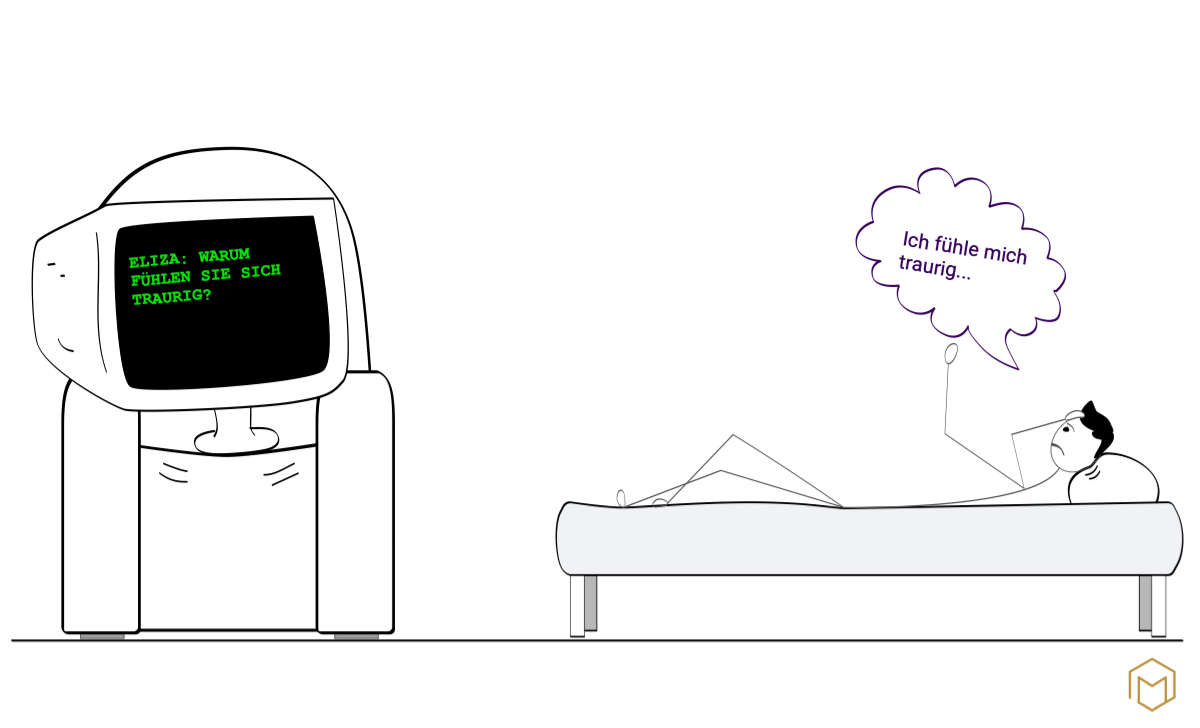
In 1966, Joseph Weizenbaum developed a programme called ELIZA at MIT. It simulated a therapist using a single technique: it simply repeated back what the user said.
"I feel sad.", "Why do you feel sad?"
That was all there was to it.
What happened next deeply shocked Weizenbaum himself; he described it in detail in his 1966 paper (https://dl.acm.org/doi/10.1145/365153. 365168). People began to attribute real feelings to ELIZA. They shared secrets. Some wanted to be alone with the programme. Weizenbaum’s own secretary, who knew it was a programme, asked him to leave the room so that she could speak undisturbed.
Weizenbaum called this the ELIZA effect: the human tendency to attribute consciousness and intentions to systems that communicate through language, even though we know they are machines.
What this has to do with modern AI
ChatGPT, Claude, Gemini and other modern language models are many times more powerful than ELIZA. They express themselves fluently, provide context-sensitive responses and come across as convincingly competent.
But the ELIZA effect has remained. It has grown stronger.
People entrust AI systems with decisions that they would never so readily leave to a human adviser. They don’t question the answers because they sound so convincing.
The difference is crucial: AI does not understand. It calculates.
What this means in practice
The ELIZA effect is not a weakness. It is a human trait. But anyone introducing AI into a business or evaluating AI-generated results should be aware of it.
Those who understand that AI has no intentions and doesn’t "mean" anything ask better questions. Make better decisions. And use AI where it really helps, rather than where it just sounds convincing.
Source: Weizenbaum, J. (1966). ELIZA, A Computer Program for the Study of Natural Language Communication Between Man and Machine.