
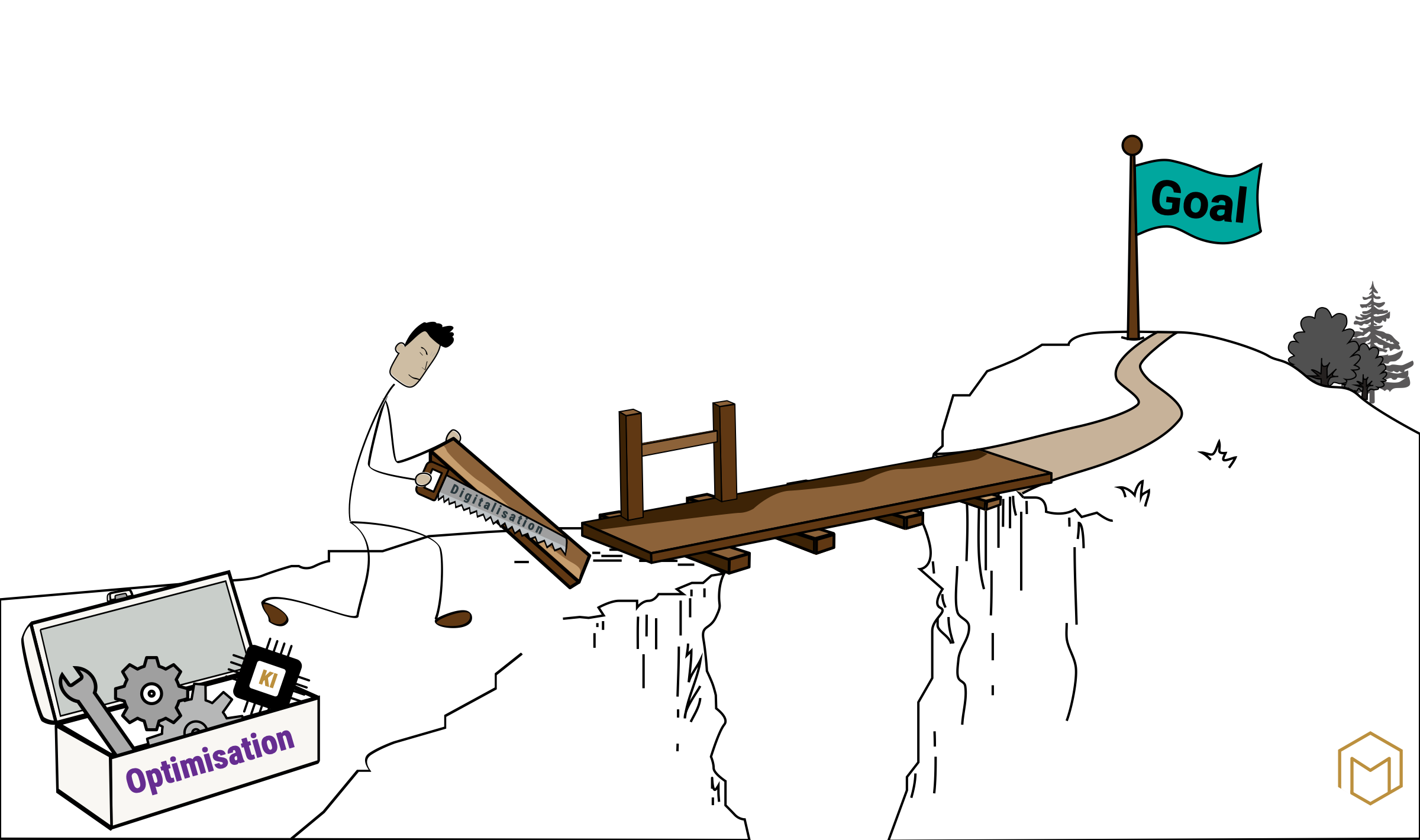
Five years ago, every strategy document stated: ‘Our goal is digitalisation.’ I asked my son, who was nine at the time, what he thought that meant. His answer was spot on: all sorts of things. Board games on the computer instead of at the table, writing on the computer – basically, everything you do on a computer instead of in real life.
Five years have passed, and he’s now a teenager. What else has changed?
Our vocabulary has expanded. The magic phrase is now ‘we have to do something with AI’. However, it hasn’t completely replaced the goal from back then. Digitalisation remains a key issue in many sectors, particularly in the energy industry.
The fallacy has remained the same: the tool is declared to be the goal. ‘We’re digitising’ and ‘we’re doing something with AI’ say nothing about which problem is to be solved. A municipal utility that introduces AI today simply because everyone else is doing so is making the same mistake as the municipal utility that built a chatbot five years ago simply because everyone else was doing so. The tool arrives, but the problems remain.
How does this manifest itself? A process that was running poorly before starts to run poorly even faster after digitalisation. An AI system superimposed on a process that nobody has fully understood simply automates the misunderstanding. The tool does not change the core issue. It merely makes more visible what was already there.
I ended the original text with a promise. In the following articles, I wrote about – and demonstrated – how I decide which optimisation method is most suitable. These posts have resulted in five years’ work, culminating in a methodology that structures precisely this choice. With HOIKEI, I now evaluate each process individually to determine how well it can be optimised, what the benefits are, and whether AI is even the right solution for it. The underlying idea has remained the same, only it has become more refined: “First the process, then the tool”. First, we ask what problem we want to solve; then we reach into the toolbox, guided by figures rather than trends.
That’s the good news. Once the question of the process has been clarified, digitalisation and AI come into their own. They save time, reduce costs and solve real problems. The supposed goal becomes a tool, and that is precisely when it becomes worth its weight in gold.