
Almost every executive presentation I’ve seen recently contains the same sentence: “We need to do something with AI.” What’s rarely mentioned alongside it is the problem it’s supposed to solve. The order is backwards. First comes the desire for AI, then the search for a task that fits it. Many even openly admit what triggered this: at the last conference, everyone was saying they were already using AI.
This pattern has a name. The fear of missing out, known in research as FOMO, has been well studied. It refers to the worry of being excluded from others’ rewarding experiences. It drives us to act simply because others are doing so. We don’t need a problem of our own for this to happen. In our private lives, it drives us to every party, for fear of missing THE one where something important is happening. The same force is at work in business. When AI is the talk of every conference, we feel that waiting on the sidelines means falling behind.
What happens next often follows the same pattern. A working group is set up, a budget is allocated, and a supplier is sought. Then the search begins for a use case that fits the technology, which has long since been decided upon. The end result is a pilot project that solves a problem nobody had asked for in the first place.
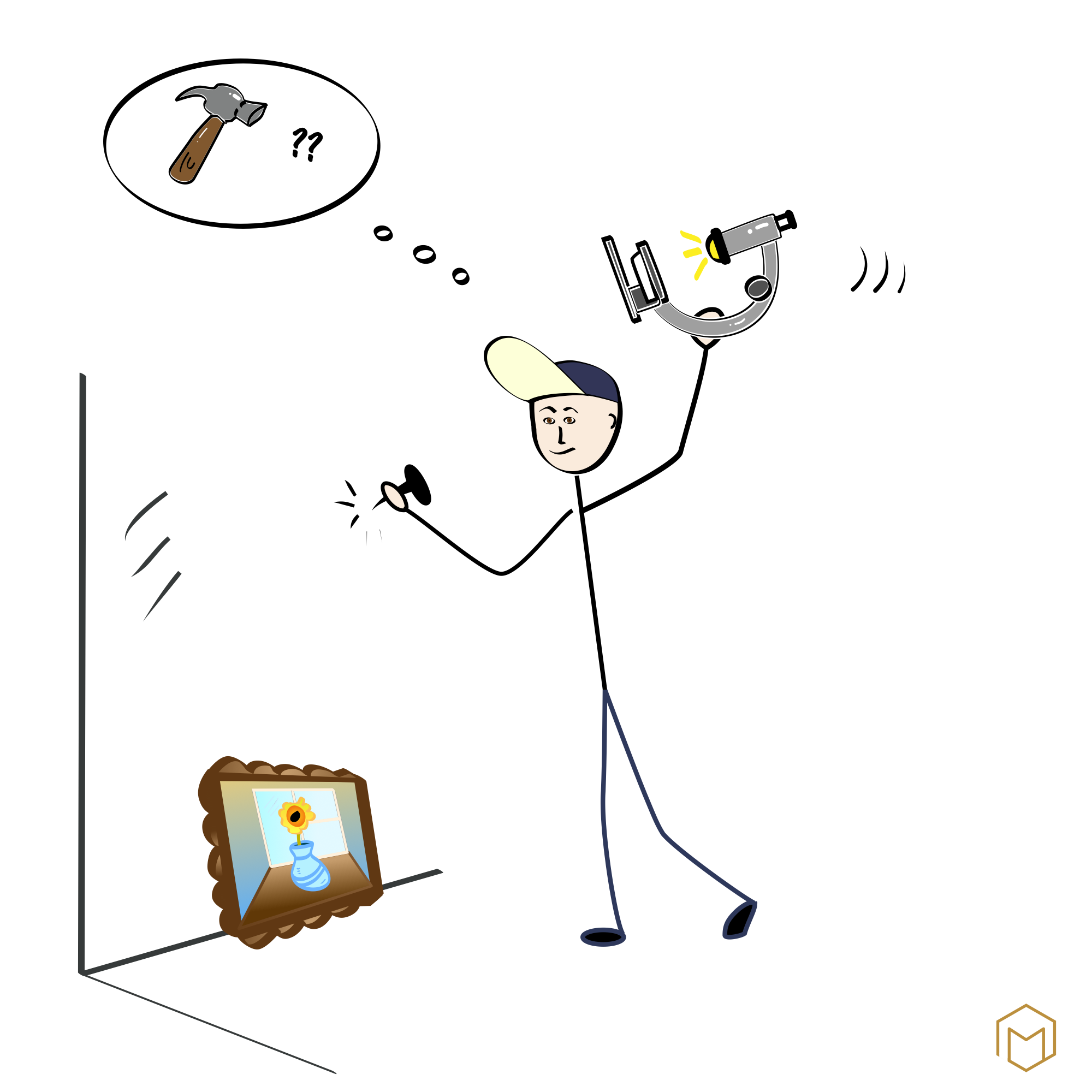
It’s as if we bought a microscope simply because everyone else had one, and then went looking for nails we could hammer in with it. And a tool that has to search for its own problem rarely finds the right one.
This comes at a cost. Resources and attention are poured into the tool, whilst the underlying issues remain unaddressed. And when the pilot project then fails to deliver as promised, someone concludes: ‘AI is a waste of time after all.’ As a result, the initial hype turns into its opposite. In both cases, no one has looked at the problem itself.
AI is just one tool among many
Generative AI is a powerful and impressive tool. But it is just one of many. Only the process itself will reveal which one is right for the job.
Sometimes the best solution is to remove a step. In one case, customer service staff had to get every goodwill credit approved by their team leader, no matter how small. A simple rule change was enough to eliminate 90% of these approvals: approval was only required for amounts of 50 euros or more. This is both the simplest and the most difficult solution, because omitting a step requires courage, but is inexpensive to implement.
Often, a process belongs in the transaction system because the procedure is clearly defined. If someone moves into a flat and the previous tenant has not deregistered, the municipal utility must request a handover report. This is an if-then rule and should be fully automated by the system. An AI add-on has no place here.
And sometimes AI is the right tool for the job. Reviewing and sorting customer complaints is one such case, as it involves language and judgement. Depending on how it is integrated with the systems, AI can even suggest the next step. Here, AI can be deployed to its full potential and fits perfectly into the process.
If, on the other hand, we start with ‘AI’, all these possibilities remain hidden from us because the solution is already fixed before the right questions have even been asked.
We’ve seen this kind of hype before with past trends. A few years ago, everything had to be RPA – those little robots that mimic human clicks. Today, the same tools are being given an ‘AI’ makeover so they sound up to date again. But the label doesn’t change the tool itself.
The problem comes first
The right tool stems from the problem itself. “Something involving AI” is merely a wish. The sensible question focuses on the specific process: where is the bottleneck? Only then can we say whether AI is the right fit, whether a simpler solution will suffice, or whether we’d be better off scrapping the idea altogether. HOIKEI can help to answer this question systematically: by assessing the potential for optimisation and carrying out an automatic AI suitability check.
In one project, I realised that the greatest benefit didn’t actually lie in the tool itself. It lay in the questions that had to be discussed during implementation. Why do we make decisions this way? What do employees actually do in everyday life? Once we fully understood the process, half the solution became immediately apparent and didn’t require a new tool.
Finally
If the next slide in the board presentation says “do something with AI”, the honest question to ask is: what problem are we trying to solve? And sometimes, it is precisely this question that brings something uncomfortable to light. The process we wanted to improve with AI is itself broken. No tool can fix that.