
Energy suppliers still receive a lot of paper-based correspondence. It’s part and parcel of the business. A form is sent out, returns once completed, and is scanned using OCR. The layout is familiar, and the software breaks it down neatly into fields and values.
Customers often fail to follow the guidelines and write notes in the margins of the document. And so people are brought in to sort such documents into a separate bin. And then there are the handwritten letters, in blue ink on squared paper, which no OCR system can cope with.
AI is now intended to solve these problems. However, the tools struggle in particular when it comes to recognising notes in the margins of standardised forms. Even if it’s on the list of features.
How do we choose a tool?
Usually based on value for money. Does it deliver the result, and how much does it cost in euros? Both are valid considerations. There is a third factor that rarely comes up in discussions: resource consumption.
When I used to plan server clusters for analytical databases, power consumption was factored into the calculations – and doubled in the case of a hot standby. This consumption was tied to the infrastructure; it was predictable and calculable, separate from reports and analyses. With AI, this is changing. Now consumption depends on what we do. Every query uses a noticeable amount of energy, and the task itself helps determine how much. The link between what we do and the electricity we need has become closer.
What AI consumes isn’t on the bill
It is now well established that AI does not run for free. Dr Dina Barbian shows that AI requires energy and water throughout its entire life cycle: from the manufacture of chips and servers, through the training of models, to every single small task.
In day-to-day business, it is primarily the usage that counts, and this is repeated. A single query may be minuscule. With Agentic AI in particular, consumption multiplies rapidly, as these queries are run thousands of times.
The ESCADE research project, in which Dr Barbian’s eco2050 Institute is involved, is investigating how energy consumption can be measured and reduced. What matters in my practice is the scale of the issue, and this is significant enough to factor consumption into decisions regarding the use of AI.
First the process, then the tool
In an earlier article, I described why the tool must fit the process, and not the other way round. Resource consumption adds another dimension to this issue. If a rule, a step in the specialist system, or the omission of a task achieves the objective, that is simpler and cheaper. And it consumes fewer resources.
Using AI where a rule or an automated process would suffice is like using a sledgehammer to crack a nut, particularly in terms of energy and water consumption.
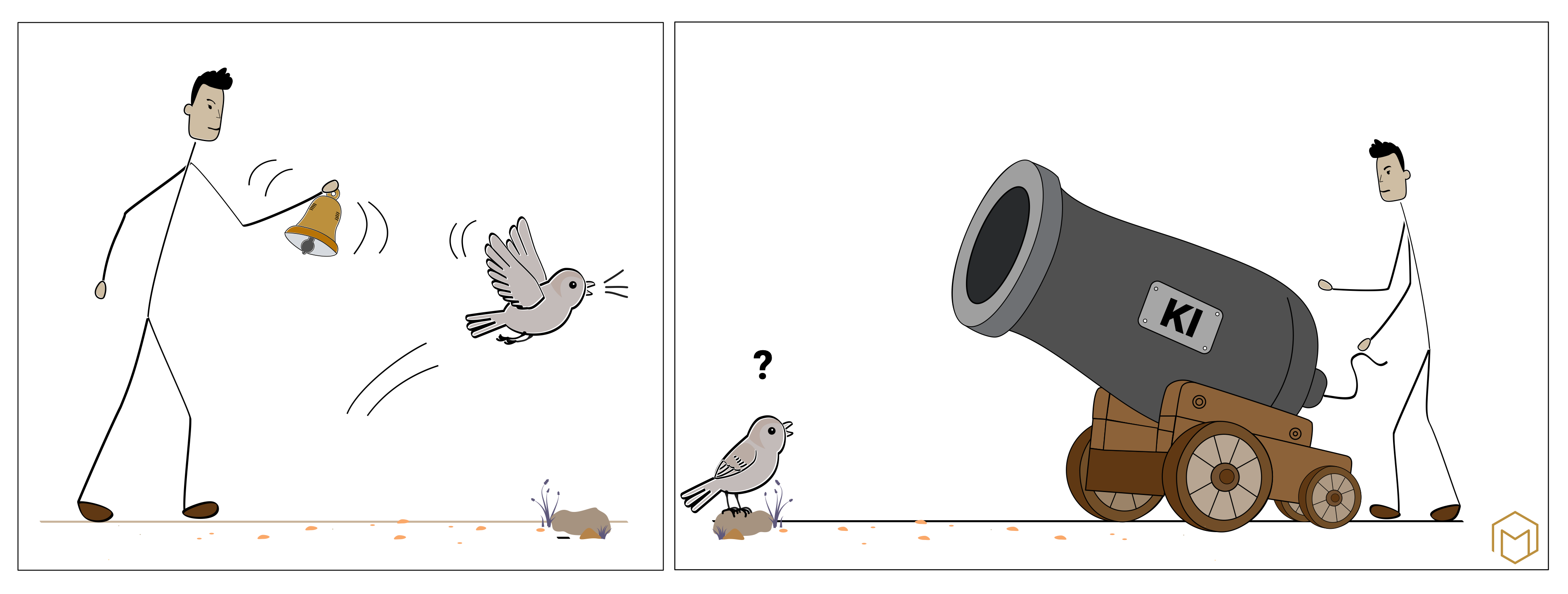
When is AI also beneficial from an environmental perspective?
That does not mean AI is a waste. Where a task requires understanding language or making a genuine assessment, nothing simpler can take it on. AI is the right tool for making sense of a detailed complaint, and the resources it consumes in doing so buy a capability that a rule does not have.
Efficiency alone is not enough
It is often said that models are becoming ever more efficient. That is true; resource consumption per query is falling. However, overall consumption is still rising because AI is taking on an increasing number of tasks.
In our day-to-day work, the greater leverage lies elsewhere. Providers decide how efficiently a model operates. We decide where we use it in the first place. And this second question must be answered anew in every process.
Good process management saves resources as a side effect
The beauty of it is that it doesn’t require a separate sustainability programme. Choosing the right tool automatically saves resources. The question of sound process management and the environmental question lead to the same answer.
Anyone who has ever filled in a form for a bank knows that it essentially says: ‘This document is scanned by a machine; data outside the designated fields will not be taken into account’. In this way, banks avoid the tedious task of recognising any notes the customer has written in the margins. Is this the best solution for a customer who wants to convey something? Certainly not. But it is the most resource-efficient. After all, such a form requires no expensive technology and the processing can be carried out entirely automatically.
Omission is usually the most economical tool of all.