
A project has been running for three years. The original timeline was twelve months; the budget is twice as high as planned; and the result is not yet operational. At the steering committee meeting, someone says: “We can’t pull out now; we’ve already invested so much.” Everyone nods. The next extension is approved.
This statement is one of the most honest but also one of the most costly in management. It describes a cognitive bias that behavioural economics has been researching for fifty years: the sunk cost effect.
What the sunk cost effect is
The sunk cost effect describes the tendency to stick to a decision because one has already invested time, money or effort. From a rational perspective, only future costs and returns should count when making a decision. Past costs are lost, regardless of how the project proceeds. They should not influence the current assessment.
In practice, however, the human brain does exactly the opposite. An example: you’ve bought a cinema ticket for twenty euros. After half an hour, you realise the film is boring. The rational thing to do would be to get up and leave. The twenty euros have been spent either way. In reality, most people stay in their seats. And spend the next two hours feeling annoyed, on top of the money they’ve lost.
Why we stick with it
The sunk-cost effect has three roots.
The first is loss aversion, described by Daniel Kahneman and Amos Tversky in their Prospect Theory. People perceive a loss as roughly twice as painful as a gain of the same amount. Kahneman illustrates this with a coin toss: would you take a bet where you have an equal chance of losing 100 euros or winning 100 euros? Most people would refuse. It is only when there is a potential gain of around 200 euros that the bet becomes attractive.
Anyone facing the decision to abandon a project after spending one million euros perceives that one million as a loss that they could still avert. Carrying on feels like salvaging the money already invested. Mathematically, this is not correct. The million is already lost, regardless of the decision to continue. Carrying on simply adds further costs to it. However, the brain does not perceive this difference.
The second root cause is cognitive dissonance. It describes the unpleasant state that arises when one’s actions and self-image do not match. Anyone who has approved a project sees themselves as a competent decision-maker. If the project goes badly, this self-image is shaken: one’s own competence and the visible outcome no longer match. This creates stress.
As long as the project continues, the problem can be put off. After all, nothing has been definitively decided yet. The outcome can still turn around. The thought ‘My decision was correct; the project just needs more time’ remains a possibility. Abandoning the project, on the other hand, would be an admission: ‘I made the wrong decision.’ Carrying on is the psychologically preferable route, as it avoids the assessment that would damage one’s self-perception.
The third factor – often the most powerful for managers – is the stigma of failure. Terminating a project is rarely seen as a neutral move. It is interpreted as a personal defeat for those in charge, regardless of the economic rationale behind the decision. Anyone who terminates a project must justify the decision. Anyone who continues it need only take responsibility for its future course. The incentive structure in many organisations rewards perseverance, even if it is more expensive.
Where the effect takes hold
Not every expensive project is a sunk-cost situation. If SAP discontinues maintenance for a core system, migration is essential, even if the project is costly or runs over schedule. If the government mandates a new communication between utilities, it must be implemented. A regulatory project cannot be abandoned. It can only be carried out better or worse. This is where prioritisation, sound programme management and an honest approach to time and resources come in (with thanks to Fred Brooks).
The sunk-cost effect operates elsewhere: in projects that are initiated voluntarily and which nobody is obliged to continue. In the case of self-initiated projects. Precisely where termination would be possible, yet still fails to materialise.
Where it becomes apparent in municipal utilities
The voicebot with no way out. After two years of pilot operation, the bot still does not even handle half of the calls independently. The decision to extend the provider’s contract is taken every quarter because terminating the contract would mean writing off the costs incurred so far as ‘lost’. The truth is: they’re already lost. The only question is how much more money is to be thrown at it.
The chatbot with diminishing returns. The system was introduced three years ago as a pioneering innovation. Usage has been declining for two years; customers prefer the service hotline. The person in charge regularly reports on new use cases designed to salvage its value. None of them are scaling.
Intent recognition in customer service. An AI system is designed to automatically classify incoming enquiries. After two years, it has achieved 70 per cent accuracy, which in practice means that one in three enquiries must be checked manually. The original business case is therefore no longer valid. The project manager is proposing enhancements rather than scrapping the project.
The Excel ecosystem in reporting. Over the years, a web of interlinked Excel files has developed in the controlling department. Each file has its own purpose, its own person in charge, and its own formulas. Together, they form the basis for monthly financial statements, forecasts and reconciliations. The administrator who set up this framework is due to retire in a year’s time. Replacing it with an integrated system has been discussed on several occasions, but the decision has been postponed every time. The argument goes: “The Excel system works, doesn’t it?” The truth is: it works because one person has all the formulas in their head. Without them, it won’t last two months.
There is a much-quoted saying: “Insanity is doing the same thing over and over again and expecting different results.” It captures the pattern perfectly. What these four projects have in common is precisely this: carrying on in the same way, in the hope that something will change at some point. The question ‘How do we salvage what we’ve invested so far?’ is therefore the wrong one.
Planned failure
The obvious answer to sunk-cost thinking is: more discipline. Taking a tougher line, making decisions more quickly, asking those responsible the difficult questions. This rarely works. The psychological forces driving this effect are stronger than any appeal to rationality.
The better approach begins earlier: the moment the project is launched. Anyone starting a project factors in the possibility of failure. As a plannable component of the project structure.
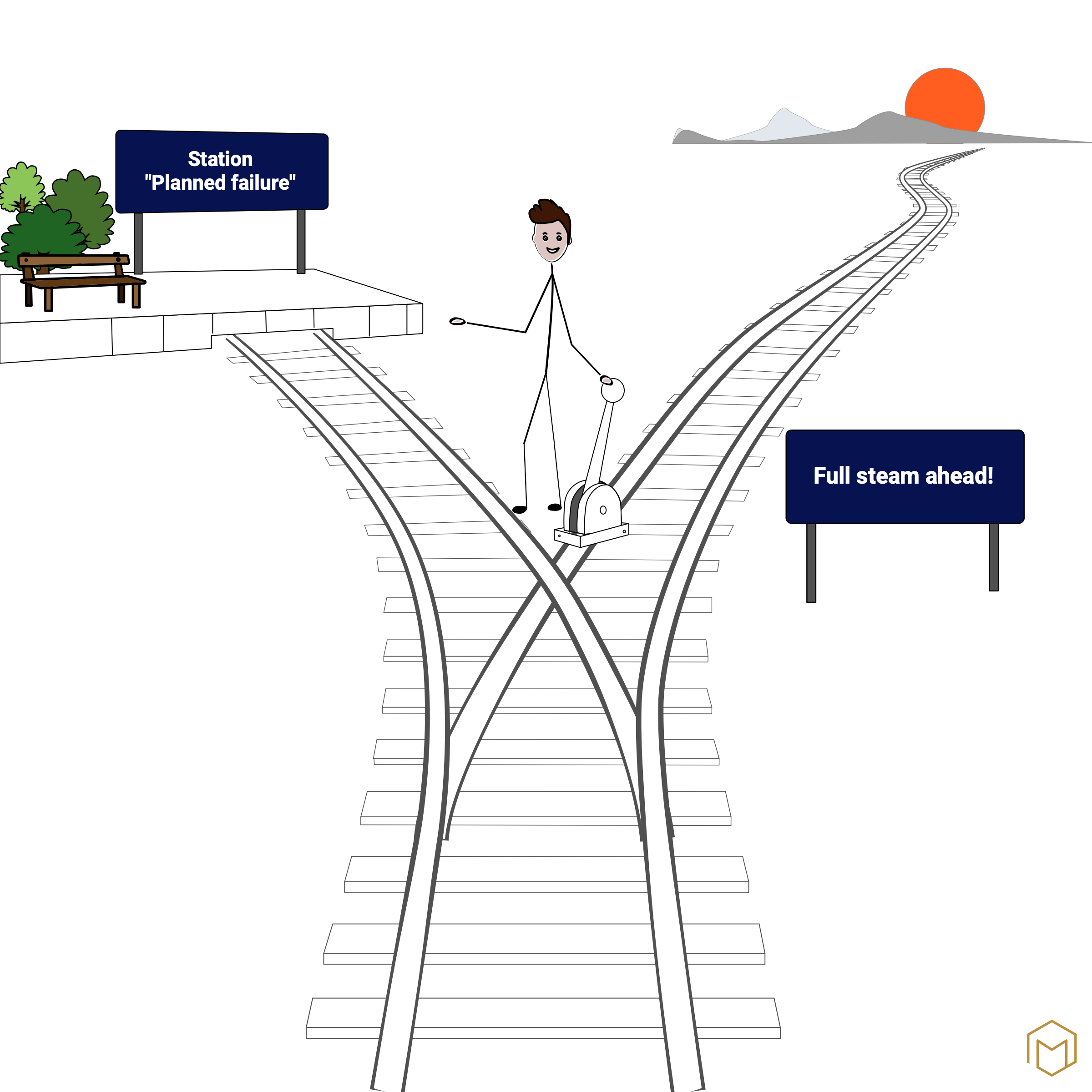
Success and termination criteria before the project starts. What are the conditions under which the project will be successfully completed or terminated? Both questions form part of the project definition. Set out in writing, signed, before the first euro is spent. Formulated unambiguously. “If, after twelve months, the recognition rate is above 85 per cent, the system will go into regular operation. If it remains below that, the project will end.” That is verifiable. “If the project delivers the expected results” is vague and leaves room for reinterpretation. A criterion that can be interpreted will be interpreted.
The tricky part is setting a realistic threshold. An 85 per cent detection rate sounds ambitious, but if the project hasn’t reached it after twelve months, it won’t reach it after 24 months either. The criteria must mark the point at which a rational observer would say: ‘From here on, it’s no longer worth it.’ Or: ‘Carry on, it’s paying off.’
Set a time limit. A pilot project with a clear end date is an experiment. At the end, a conscious decision is made: to put it into operation or to terminate it. The two options are equally valid. In an experiment, termination is planned from the outset.
The end date should be set in such a way as to allow for a meaningful evaluation. Six months is usually too short for an AI pilot, whilst eighteen months is too long. Twelve months, with an interim review after six months, is a timeframe that works well in many organisations. It is important that the end date is a clearly defined part of the project definition.
Set a cap on resources. If you say, “Let’s try it with 200,000 euros and one person-week per month”, you establish a natural limit. An open-ended budget encourages a creeping continuation of the project. Once resources are exhausted and the criteria have not been met, the decision becomes easier. It looks like the planned end of a defined investment.
The cap should apply to both the budget and staff time. A project that is no longer allowed to tie up staff resources comes to an end even if the budget has not yet been exhausted.
Provide a rationale for termination. A project that ends on the basis of a predefined criterion is completed as planned. The person in charge made the right decision to launch the project in order to clarify the issue empirically. They also made the right decision to terminate it once the answer was established. Both decisions are successes.
This framing is a structural prerequisite, not a cosmetic one. As long as discontinuation is interpreted as failure, it will be avoided. As long as it is seen as the planned conclusion of an experiment, it becomes a normal option. Culture changes with language.
The reward lies in failing better.