
Is the churn rate likely to reduce your profits? Is the churn curve outpacing the cost of acquiring new customers? Have you tried any customer retention programmes?
If you have looked into this issue, you have no doubt already tried to identify common patterns in customer churn and find plausible explanations for the reasons behind it. You may have discovered in the process that there were an unusually high number of customers leaving in certain neighbourhoods, or that there is a temporal correlation with complaints. As it’s never a bad idea to improve how we deal with dissatisfied customers, customer service representatives are receiving additional training and a supply of Amazon vouchers. They hope that these measures will be effective and that the issue will become less of a concern. If the real reason for cancelling is something else, they will have achieved very little.
The crux of the matter is that there is usually not ‘just one’ reason for cancellation. I know this from my own experience: it is rather a combination of reasons that prompts me to switch insurance providers, electricity suppliers or banks. Identifying this unique combination ‘manually’ for my customers is difficult. This is because we, as humans, quickly reach our limits when we have to consider more than two or three influencing factors and their interrelationships. Fortunately, data scientists have been working on this topic for a long time and have a whole host of clever algorithms at their disposal, which fall under the umbrella term ‘predictive analytics’. Artificial intelligence utilises the same methods, so the basic principles I describe below apply equally to many AI systems.
What is ‘Predictive Analytics’?
Data scientists often come across as modern-day shamans. They perform a data dance and, after a while spent uttering incomprehensible but melodious words, they prophesy that there will be a flood of resignations over the next three months. They say that Marta Meier and Huber Peters require our utmost attention if we want to retain them as customers.
What makes you say that?
The short answer is: you teach the algorithm to distinguish a ‘churn customer’ from a loyal customer. Data scientists, of course, do not speak to the long gone ancestors, but instead use algorithms from the fields of “predictive analytics” and “AI”.
 For a long answer, I need strawberries and tomatoes.
How do you get someone who has never seen anything like this in their life to tell them apart based solely on their appearance?
To do this, you need a lot of labelled pictures of roses and shade-loving plants so that ‘the apprentice’ can learn to recognise them.
Most tomatoes are larger than strawberries. Furthermore, we find ‘little dots’ (the actual fruits) on the skin of strawberries, whereas the surface of tomatoes is smooth. In the language of data scientists, we have identified two variables:
- Shape
- ‘Little dots’
Now it’s time to sort them. All the large ones go into one pile. The rest are sorted according to the ‘little dots’ on their skin.
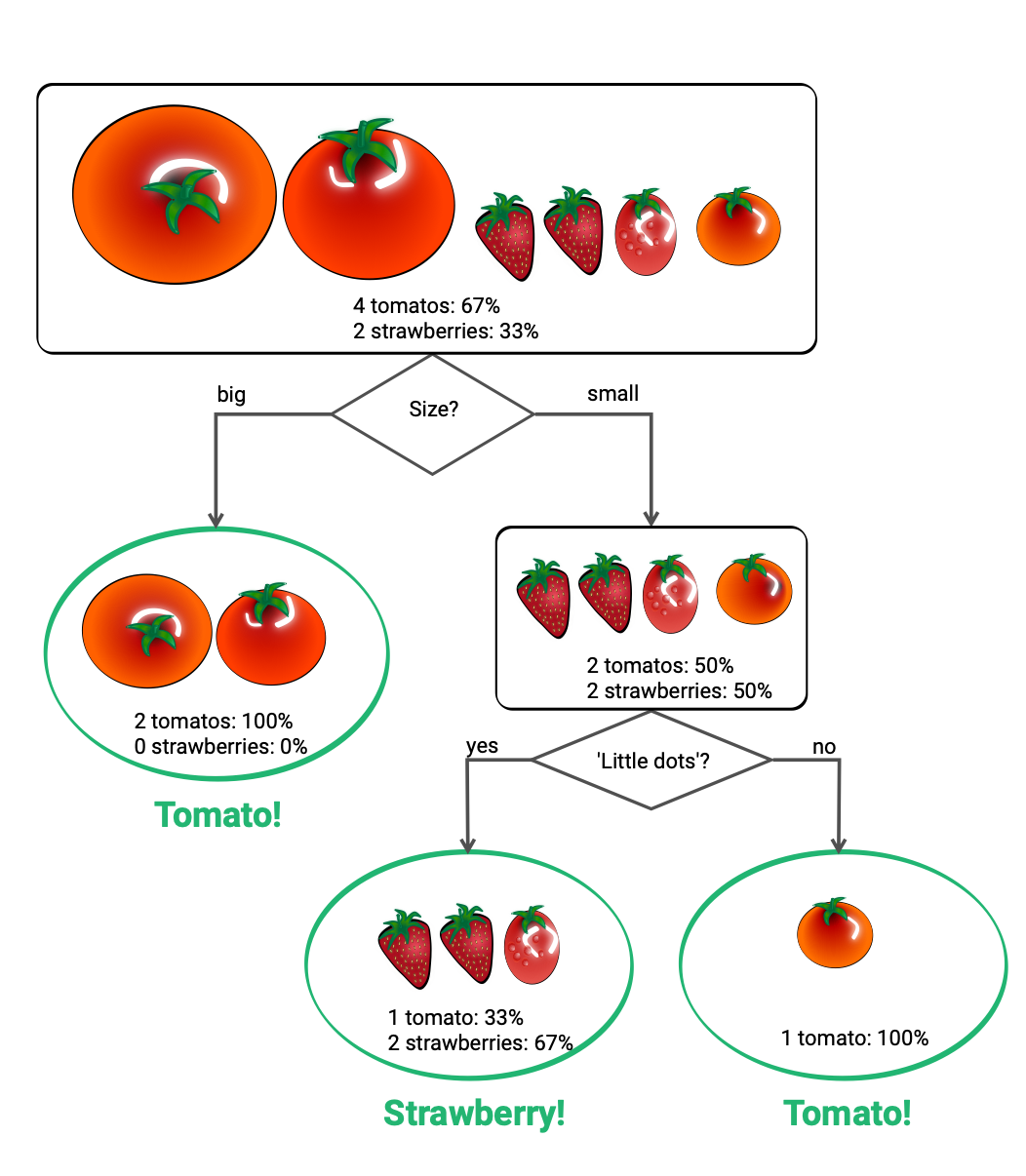
After a few iterations, the algorithm determines for itself which variables are relevant and uses them going forward; this is why data scientists feed the programme as much data as possible. In our example, it makes sense to include shape as a variable to improve the quality of the classification. Once the recognition is working reliably, the model is considered trained and is able to identify images independently. It always specifies the probability that a strawberry or a tomato has been recognised.
This is exactly how a model for churn detection is created. Significantly more variables are used: customer age, gender, contract age, additional payments, refunds, reminders, region, product, credit rating, usage, etc. Training is based on historical data: for each data point, it is clear whether it represents a strawberry or a customer who has cancelled their contract.
If the detection is reliable, the model is applied to recent data, enabling us to obtain a list of customers who may be at risk of leaving. To avoid any misunderstanding: strictly speaking, the algorithm does not predict customer churn. It determines whether a person exhibits characteristics typical of someone who is likely to cancel their contract.
Now is the time to take action: for example, the most valuable customers receive a call from a call centre agent who asks about their satisfaction and makes an attractive offer. Others receive a product offer by email. It goes without saying that the GDPR must be observed here. This lays the foundation for a prevention programme. You can find out what other ingredients are needed to achieve tangible results in the next section.
A recipe for successful churn prevention
Simply setting up a model and launching the first campaign is by no means enough. The algorithm requires regular training, whilst the retention measures need to be adjusted and their effectiveness measured; therefore, only a structured and consistently implemented customer churn prevention programme will lead to long-term success. I’ll be discussing the secret ingredients for success with Peter Neckel, Head of Customer Analytics at Positiv Thinking Company.
What is your formula for successful churn prevention? Is there a secret ingredient?
A churn prediction model attempts to forecast future potential customer churn. This cannot be achieved with traditional reporting; methods from machine learning and data mining are required.
However, other, non-technical factors are usually crucial to the success of such a project: these range from cross-functional collaboration – involving staff from customer service, sales, marketing, product management and IT – at the earliest possible stage, through joint campaign and action planning, to the establishment of a feedback loop in which campaign results are used to improve the next churn prediction. Successful implementation requires a high degree of coordination, for which sufficient project time should be allocated.
How is success measured?
Success can be defined in many different ways. However, in most cases, it’s too soon to pop the champagne corks as soon as the data scientist reports having trained a classification model for churn prediction with high accuracy.
This is because, between calculating the probability of churn per customer and successfully winning back customers, there are key questions to be answered: Which of the potential chippers-off can and am I likely to be able to prevent from cancelling their contract, and with exactly which measure? When it comes to implementation, this then involves, for example, determining the channels and topics for customer engagement, the timing of contact, cost-benefit analyses, the formation of control groups, and the nature and scope of data collection during customer engagement, etc.
In order to be rewarded with a high customer retention rate at the end of the evaluation phase, the aforementioned process steps must be carefully designed and orchestrated in each individual case.
Why is training the model so important?
Training an AI model for churn prediction is one component of a multi-layered process. The accuracy of a model depends on many factors, including the quality of the underlying data.
It is important to strike a balance between data recency and volume: on the one hand, many forecasting methods require a minimum amount of training data; furthermore, data spanning several years of history helps to smooth out seasonal fluctuations. On the other hand, data loses a great deal of its predictive power (in some cases, such as customer behaviour data, even exponentially) – and thus its value – the older it gets. Therefore, models in production should be regularly reviewed and, where necessary, retrained using up-to-date data. Unfortunately, this is often neglected in business practice.
You have been working successfully in the field of data science for 15 years. What mistakes should be avoided at all costs?
Do not underestimate the complexity of the task! Churn prevention is about much more than just data science. In most companies, there is no operational customer retention process in place before the analysis begins for customers who have not yet cancelled their service at the time of contact. This process must be created from scratch and tested in practice with all stakeholders during the project, including everything that goes with it: new areas of responsibility and accountability for results, cross-departmental structures and processes. This is no small matter, as it entails massive changes to the organisation and corporate culture. It is also because, for example, before customer retention campaigns can be carried out, mutual trust must first be established in the accuracy of forecasts generated using AI methods. It is not without reason that it is said: “The hardest part of a successful transformation is the cultural piece”.